Composition: A Gateway Framing the Lane
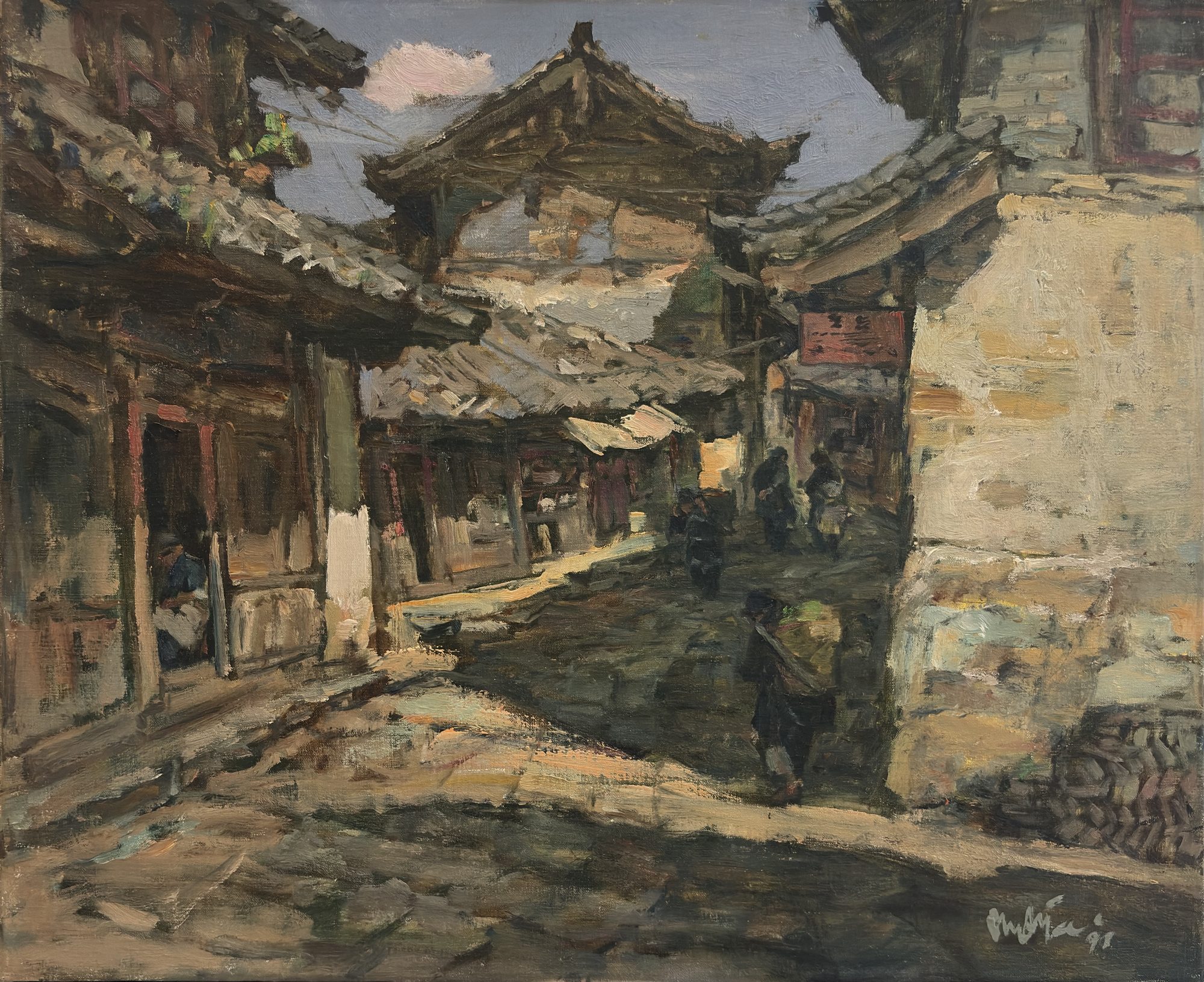
The composition is organised around a timber gateway with a pavilion-style roof and upswept eaves, which stands near the centre of the canvas. Tiled roofs project in from both sides, so that the sky appears as an irregular opening between them. On the left, a dark colonnaded veranda runs back into the picture; on the right, a large wall of cream and ochre rises as a broad plane of light, with a red sign hanging near its upper edge. The lane runs diagonally from the lower right toward a bright opening beyond the gateway.
A broad band of shadow crosses the foreground and the middle of the lane, and it divides the picture into light and dark. The figures in the distance are caught in a shaft of sunlight, and the gateway frames them. As a result the eye is led through the shadow of the foreground, past the porter, and toward the small bright area at the heart of the picture.
Colour Scheme
The palette is built on the contrast between a warm, sunlit ochre and a cool, deep olive-brown. The right-hand wall is painted in cream, straw yellow and pale orange, with touches of blue-grey that stop the warmth from becoming flat. The shadows are not black: they are mixed from olive, brown and green-grey, and their depth gives the sunlit passages their glow. The sky is a dusty blue, with a pink-white cloud at the upper left that is the only soft form in the picture.
Red is used sparingly. The hanging sign on the right wall and the posts of the veranda on the left supply it, and each time it appears it anchors a corner of the composition. This is the most warmly lit of the four paintings in this group, and its colour depends upon how much of the canvas is left in shadow.
Look at the shadow across the foreground. It is not a flat dark: layers of olive, brown and blue-grey have been dragged over one another, so that the pavement keeps its texture even in the dark.
Brushwork and Technique
The tiled roofs are described with short, stacked strokes of grey, cream and green that suggest the rows of tiles without counting them. The lit wall on the right is handled in broad, buttery strokes that sit on top of the thinner paint beneath, and the sunlit pavement is built from similar slabs of pale paint. By contrast the shadows are painted thinly, and the canvas weave is visible in several of them.
The painter's decision to keep the shadows thin and the lights thick follows a familiar logic of oil painting, and it gives the picture its sense of depth: the light areas come forward and the dark areas recede.
Figures and Life
A porter, bent forward under a basket carried on his back, walks through the lower right of the canvas, painted in dark clothes against the dark pavement. Beyond him, two or three figures walk in the shaft of light, and a seated figure in blue can be seen under the left veranda. They are rendered in a few strokes, but their placement gives the lane a sense of everyday movement, and they make the architecture a place rather than a set.
Signature and Date
The painting is signed in the lower right in pale grey-white paint, followed by the date, which appears to read '97. The pale signature stands out against the dark shadow in the foreground, so it is easily read.
Interpretive Assessment
China Street Scene is a painting about light as much as architecture. The gateway, the roofs and the figures matter, but the real subject is the way sun enters a narrow lane and turns a plain wall into a field of warm colour. The picture shows how, in Tan Choh Tee's work, a strongly built composition can be combined with a free and generous touch.
The catalogue details and context should be completed from reliable documentation. In particular, confirm the title, the town depicted, the date, the dimensions, provenance and any known exhibition history before treating this interpretation as a final collection record.
Object Information and References
Catalogue data
Artist: Tan Choh Tee [Add Chinese name]
Title: China Street Scene [Confirm whether this is the original title]
Year: 1997
Medium: Oil on canvas
Dimensions: 53.5 × 65 cm (height × width)
Location depicted: [Confirm]
Provenance: [Add documented ownership history]
Exhibition history: [Add, if documented]
Bibliography
[Add publications, archival records, artist statements and exhibition catalogues used in the research.]