Composition: A Lane Receding into Depth
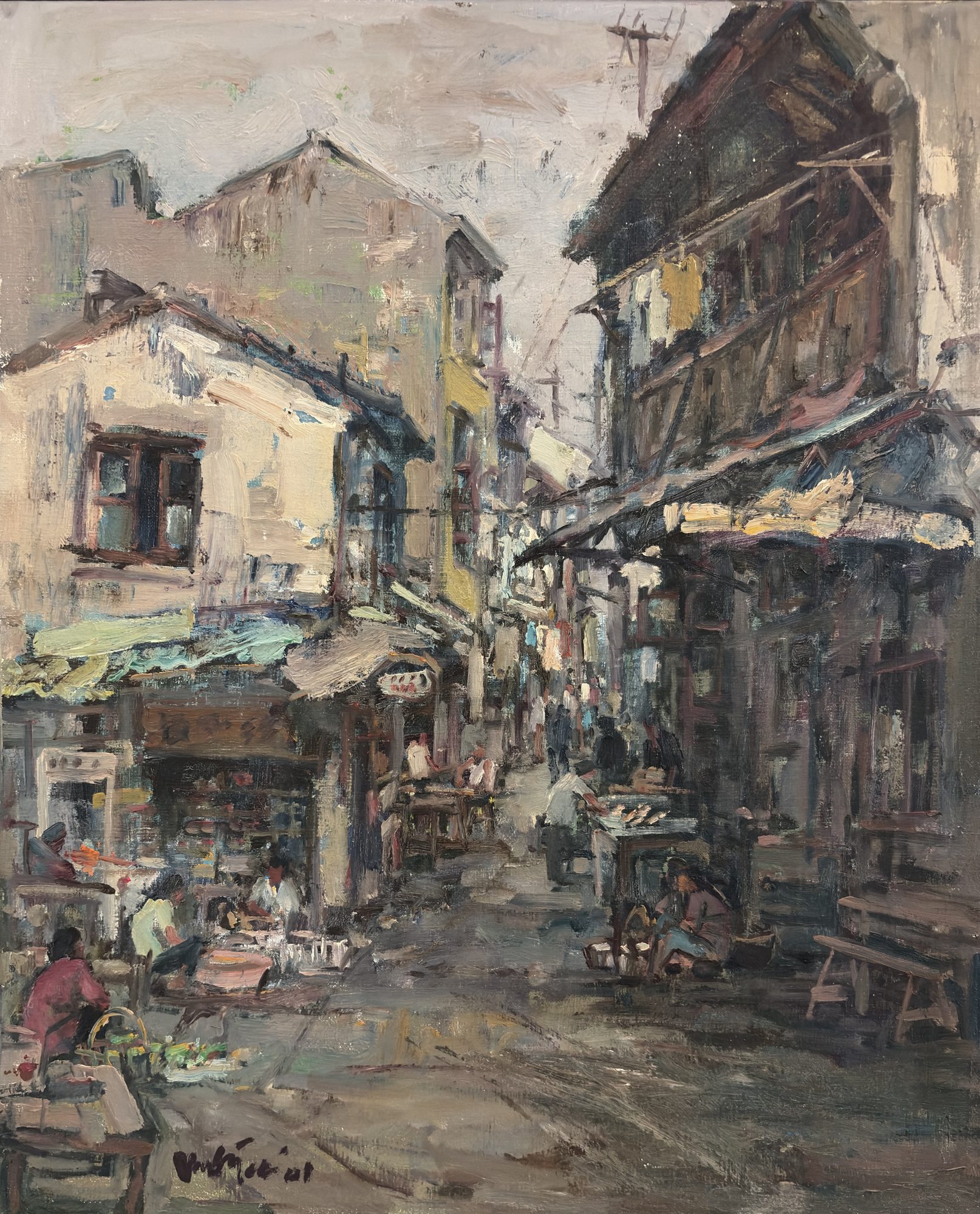
Unlike the other three works in this group, this painting is vertical, and the format suits its subject. A narrow lane runs from the foreground toward a vanishing point in the upper middle of the canvas, with buildings pressing in from both sides. On the left, a whitewashed building with a brown-framed window rises above a row of awnings. On the right, a darker timber-framed building leans over the lane, with clothes hanging from its upper storeys. Utility poles and wires cross the pale sky, a reminder that the scene is contemporary.
The lane is crowded with detail at ground level. In the lower left a woman in a rose-red jacket sits beside a basket of greens, other vendors work at their stalls beyond her, and at the right a stall with fish stands near a pair of wooden benches. Further up the lane, small dark figures walk toward the vanishing point. This arrangement leads the eye upward along the lane, so that the viewer moves from the nearby vendors to the distant crowd.
Colour Scheme
This is the softest palette of the four. The sky is an overcast taupe-grey, scumbled in broad strokes, and the buildings are painted in cream, warm grey and brown. Against this restrained ground, a few colours are allowed to speak: the awnings on the left in pale green and teal, the yellow garment hanging on the right, the cream strokes of the awning above the stalls, and the rose-red of the seated woman's jacket in the lower left.
The use of accent colour is carefully distributed. Teal on the left, yellow on the upper right, and rose in the lower left form a loose triangle across the canvas, so that the eye moves in a circuit around the lane before it settles on the distant figures.
Look at the awnings above the left-hand shops. They are painted with thick, ragged strokes of pale green and cream that stand off the surface, and they catch the light like real fabric, while the wall behind them is painted thinly.
Brushwork and Technique
The surface of the painting is varied. The sky is thin and dragged, with the canvas weave clearly visible. The awnings and the stalls are thick, and the paving is handled in loose, horizontal strokes of grey and brown that suggest wet ground and reflections. The architecture is described with a few angular strokes that set out the planes of the walls and roofs without detailing every window. The figures are even more economical: a vendor in a white shirt is little more than three or four strokes of white and grey.
This economy gives the picture its immediacy. Everything seems to have been put down quickly and decisively, yet the whole holds together because the tonal values are controlled from foreground to distance.
Figures and Daily Life
Where the other paintings in this group include only one or two figures, this one is populated. The vendors in the foreground, the shoppers in the middle distance and the walkers far up the lane describe a market in the course of a day. They are anonymous, and the painter does not single anyone out, but together they define the character of the place.
Signature and Date
The painting is signed in the lower left in dark paint, followed by the date, which reads '01. The dark signature sits against the lighter paving at the bottom of the canvas and is easily read.
Interpretive Assessment
Street Scene (2001) shows a different side of Tan Choh Tee's practice from the sunlit pictures of 1997. Light is diffuse, colour is muted, and the subject is the ordinary activity of a market lane. The vertical format, the converging perspective and the scattered accents of colour give the picture both order and liveliness.
The catalogue details and context should be completed from reliable documentation. In particular, confirm the title, the place depicted, the date, the dimensions, provenance and any known exhibition history before treating this interpretation as a final collection record.
Object Information and References
Catalogue data
Artist: Tan Choh Tee [Add Chinese name]
Title: Street Scene [Confirm whether this is the original title]
Year: 2001
Medium: Oil on canvas
Dimensions: 65 × 53.5 cm (height × width)
Location depicted: [Confirm]
Provenance: [Add documented ownership history]
Exhibition history: [Add, if documented]
Bibliography
[Add publications, archival records, artist statements and exhibition catalogues used in the research.]