Composition: A Lane of Signs and Awnings
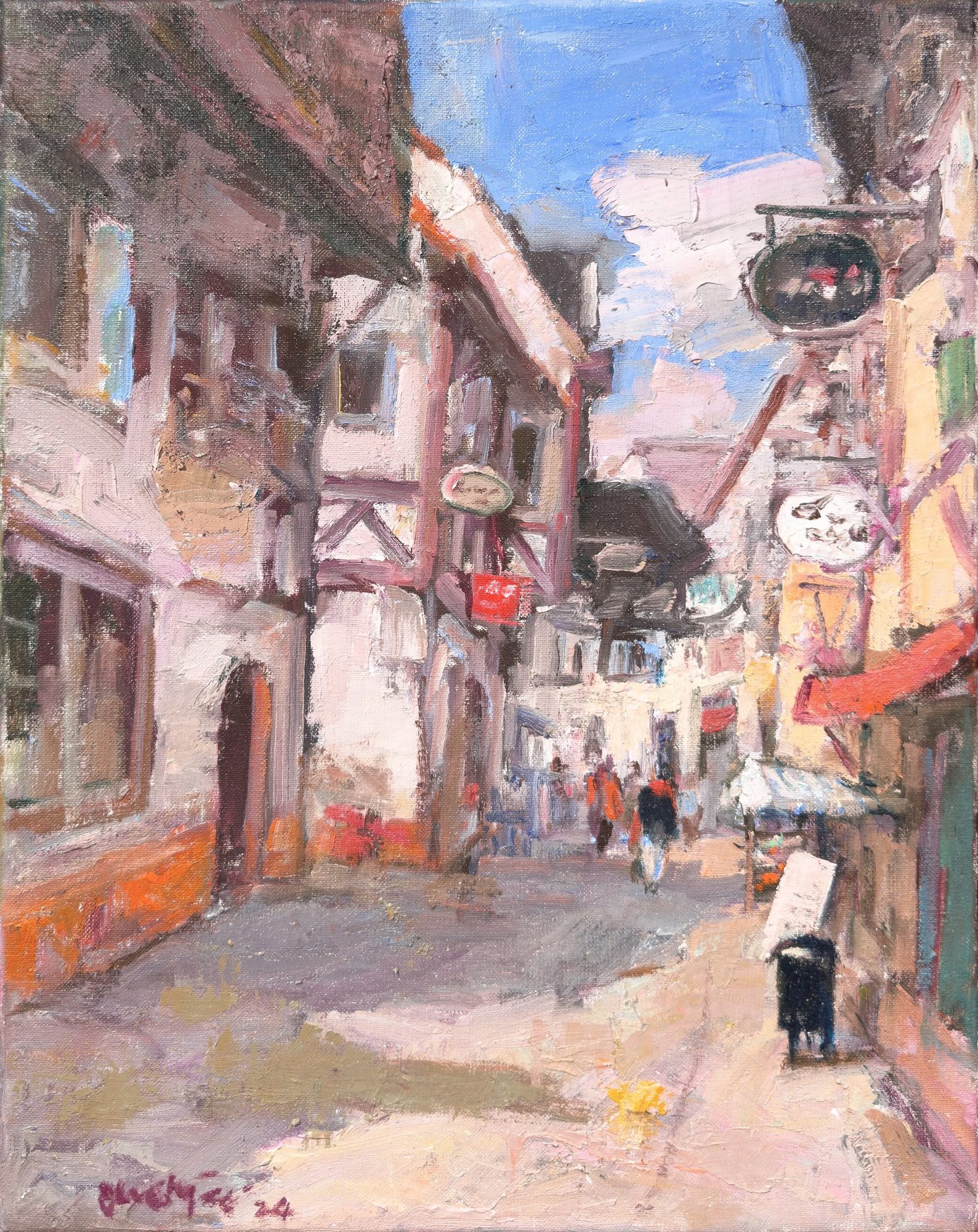
A narrow street runs from the lower foreground into the distance, where it opens into a brighter area and a small group of walkers. Tall buildings crowd both sides, with a half-timbered, whitewashed house on the left and a yellow-ochre frontage on the right. The sky is a narrow wedge of blue between the rooflines, which gives the street a canyon-like depth.
Hanging shop signs, in oval and round shapes, project from the walls on both sides, and a red awning and a striped awning mark the shop fronts at the right. A dark bin and a sandwich board stand in the right foreground. These objects give the lane its character as a place of small businesses, and they set up a rhythm of light and dark shapes that leads the eye toward the figures at the centre.
Colour Scheme
The painting is built on a contrast between a strong blue sky and a pale, warm lane. The walls are mauve, plum and cream, with grey and pink shadows, and the paving is a sunlit peach with violet-grey shade in the left foreground. The sky is the most saturated blue of the four paintings, and it is placed directly above the lightest part of the street.
Accents of vermilion and orange keep the pale palette from becoming cool. They appear at the awning on the right, the base of the building at the left, the small sign at the centre and the clothing of a walker in the distance. A touch of yellow in the lower foreground and a dark green door at the right complete the range.
Look at the whitewashed wall at the left of the centre. It is not a single white: strokes of pink, lilac, cream and grey are laid over one another, and the dark timber and the arched doorway beside it are drawn with a few thick, sure strokes.
Brushwork and Technique
The walls are painted in broad, creamy strokes that follow the planes of the buildings, with the grain of the canvas showing through at the edges. The half-timbering is suggested by a few diagonal and vertical lines in plum, and the signs are single, simplified shapes with a few marks for their lettering. The paving is rendered in wide, flat touches that follow the perspective of the street, and the sky is laid in with a smooth, dense blue that contrasts with the textured surfaces below it.
Variation of touch of this kind lets each material in the scene have its own character without any change in the overall handling, and it keeps the many small signs and shopfronts from becoming fussy.
The Walkers and the Signs
The walkers in the distance are the human focus of the picture. One is in an orange jacket and another in dark clothing, and they are painted in a few strokes against the pale paving. Their placement at the centre of the lane, below the point where the walls converge, gives them importance beyond their size, and the hanging signs around them suggest the commerce of a town centre.
Signature and Date
The painting is signed in the lower left in deep maroon paint, followed by a small date that appears to read '24 and should be confirmed against the original. The maroon is close to the plum shadows of the walls, and it sits against the warm paving of the foreground.
Interpretive Assessment
Streets of Dieburg is the brightest and most graphic of the four German townscapes. It makes a strong picture from a very ordinary subject, a shopping street, by controlling the contrast of blue sky, pale walls and small bright accents, and it shows Tan Choh Tee's ability to handle a crowded scene with a few confident marks.
The catalogue details and context should be completed from reliable documentation. In particular, confirm the title, the exact street and viewpoint depicted, the date, the dimensions, provenance and any known exhibition history before treating this interpretation as a final collection record.
Object Information and References
Catalogue data
Artist: Tan Choh Tee [Add Chinese name]
Title: Streets of Dieburg [Confirm whether this is the original title]
Year: 2024
Medium: Oil on canvas
Dimensions: 50 × 40 cm (height × width)
Location depicted: Dieburg, Germany [Confirm exact street and viewpoint]
Provenance: [Add documented ownership history]
Exhibition history: [Add, if documented]
Bibliography
[Add publications, archival records, artist statements and exhibition catalogues used in the research.]